
Precision motion systems require compact components capable of handling multi-directional loads without compromising stiffness. In many industrial applications, limited installation space makes traditional bearing combinations difficult to implement effectively. Structural rigidity becomes a critical design factor.
When multiple bearings are used to support radial, axial, and moment loads, alignment errors and assembly complexity increase. Over time, tolerance accumulation reduces positioning accuracy and leads to higher maintenance requirements in high-performance machinery.
To solve these challenges, manufacturers adopt integrated bearing designs that combine load capacity and rigidity into a single unit. This approach improves installation efficiency, enhances rotational stability, and supports long-term operational reliability in demanding environments.
Integrated RU cross roller bearing for Precision Motion
The Industry Problem – Rigidity Loss in Compact Designs
High-precision machinery such as robotic joints and rotary tables requires strong resistance to deformation. Conventional setups often use separate radial and thrust bearings. This increases component count and complicates installation.
Common problems include:
Reduced stiffness under moment load
Complex mounting alignment
Increased assembly time
Higher maintenance frequency
Limited installation space
These factors directly affect machine accuracy and operational stability.
The Solution – Integrated RU Cross Roller Bearing Structure
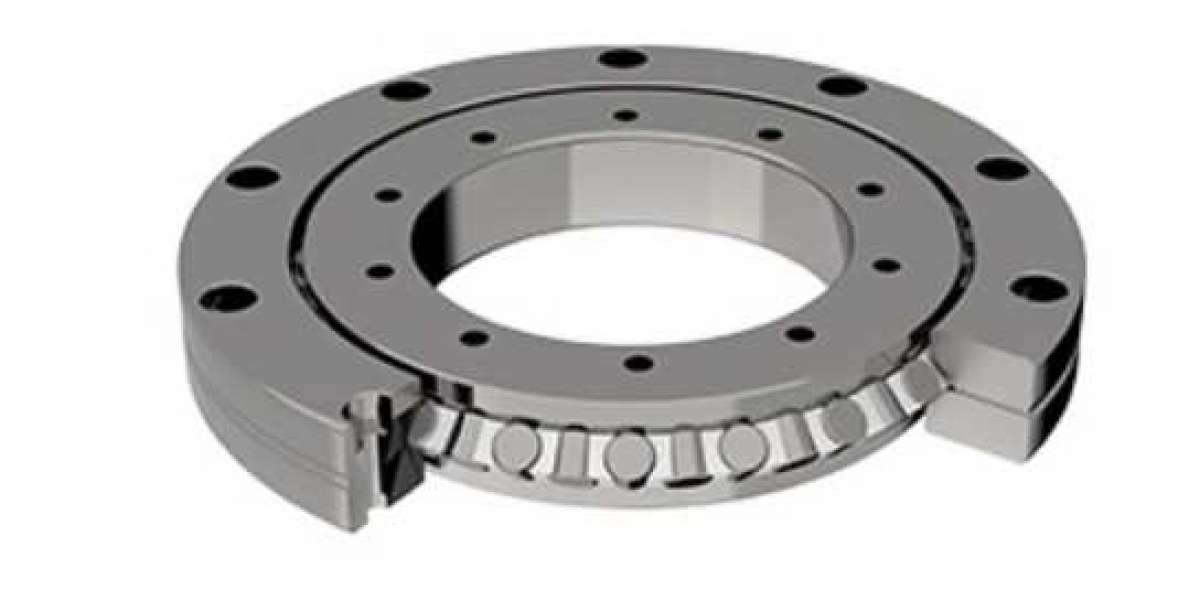
An advanced RU cross roller bearing integrates the inner and outer rings into one solid structure. This integrated design improves rigidity and simplifies mounting. Pre-machined mounting holes allow direct bolt-on installation without additional housing preparation.
Inside the bearing, cylindrical rollers are arranged alternately at 90 degrees. This crossed configuration allows the bearing to handle radial loads, axial loads in both directions, and tilting moment loads at the same time.
By evenly distributing forces across line-contact rollers, the RU cross roller bearing reduces elastic deformation and maintains precise rotational movement.
Key Features That Deliver Stability and Accuracy
Precision-engineered features include:
Integrated inner and outer ring construction
High rigidity under multi-directional loads
Compact structure for space-saving design
Pre-drilled mounting holes for easy assembly
High load capacity in radial and axial directions
Smooth rotational accuracy
These features reduce installation errors and enhance long-term mechanical stability.
Comparison – Standard Cross Roller vs RU Integrated Type
| Feature | Standard Cross Roller | RU Cross Roller Bearing |
|---|---|---|
| Ring Structure | Separate rings | Integrated rings |
| Installation Complexity | Higher | Simplified |
| Rigidity | High | Very High |
| Mounting Preparation | Required | Minimal |
| Space Efficiency | Good | Excellent |
This comparison shows why integrated designs are preferred in compact, high-precision systems.
Real Industrial Applications
High-rigidity bearing solutions are essential in industries requiring precise motion control. Applications include:
Industrial robotics joints
CNC rotary indexing tables
Semiconductor production equipment
Medical imaging systems
Precision measurement devices
In these systems, a properly selected RU cross roller bearing ensures stable rotation and accurate positioning.
Why Manufacturers Prefer RU Cross Roller Bearing Solutions
Manufacturers value simplified assembly and structural strength. Key advantages include:
Reduced component count
Lower installation time
Improved structural stiffness
Enhanced positioning accuracy
Longer service life
Integrated designs also reduce the risk of misalignment during installation.
How to Select the Right RU Cross Roller Bearing
Engineers should evaluate:
Maximum radial, axial, and moment loads
Required rotational accuracy
Mounting bolt pattern compatibility
Preload specification
Operating speed
Lubrication and environmental conditions
Selecting the correct model ensures long-term reliability and stable performance.
Conclusion
In modern precision engineering, compact design and structural strength must work together. Integrated RU cross roller bearing solutions provide high rigidity, multi-directional load support, and simplified installation. For manufacturers focused on accuracy and durability, this bearing type offers a practical and efficient solution for demanding industrial applications.